
Lagos has earned a reputation as Nigeria’s infrastructure capital. Over the years, both the Federal Government and the Lagos State Government have invested heavily in road construction, bridges, rail transportation, and other critical infrastructure that have transformed the state’s landscape and improved the movement of people and goods.

The continuity of governance and the commitment of successive administrations to building on the achievements of their predecessors deserve commendation. This consistency has made Lagos a model for sustainable urban development in Nigeria.

Another area in which the State Government deserves commendation is security. The state’s security architecture has continued to strengthen the safety of residents and businesses through collaboration with security agencies, investment in surveillance and emergency response. The progress made in this regard is worthy of recognition and serves as a model that other states in Nigeria can emulate in the collective effort to build a safer and more secure nation.
Yet, amid these remarkable achievements, there remain a few critical areas that require urgent attention—not because government has failed, but because development is a continuous process.
One such location is Ile Zik Bus Stop, popularly known as Ikeja Along Bus Stop, on the Oshodi-Abeokuta Expressway.
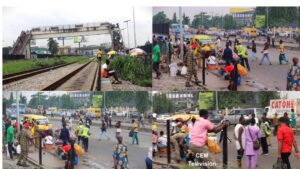
This is arguably one of the busiest bus stops along the corridor. It serves as a major transit point for thousands of commuters travelling daily from Abeokuta, Sango-Ota, Agbado, Ifo, Iyana Ipaja, Agege, Oshodi, Lagos Island and several adjoining communities. It is also the principal gateway to the famous Computer Village, Nigeria’s largest information and communication technology (ICT) market.
Every day, thousands of passengers alight at this bus stop with one destination in mind—crossing to the Computer Village axis. Unfortunately, crossing the expressway has become a dangerous gamble.
Commuters are forced to weave through fast-moving vehicles travelling in both directions. In many instances, men, women, students, senior citizens and even people carrying heavy loads literally struggle with speeding traffic in a desperate attempt to reach the other side of the road.
This daily reality has led to avoidable road crashes, serious injuries and, tragically, the loss of innocent lives.
What makes this situation even more painful is that part of the solution already exists.
An overhead pedestrian structure currently spans the railway line serving the area, but it terminates at the bus stop without extending across the expressway. Extending this existing bridge over the Oshodi-Abeokuta Expressway to the Ile Zik side would provide a safe crossing for thousands of commuters every day.
Such an extension would not only save lives but also improve traffic flow by reducing the frequent interruptions caused by pedestrians attempting to dash across the highway. It would enhance public safety, improve access to Computer Village, and further reinforce Lagos’ reputation as a city that prioritises the welfare of its residents.
This is not merely a request for another infrastructure project. It is a passionate appeal for a life-saving intervention.
As governments continue to invest in roads, rail transport and urban renewal, equal attention should be given to the safety of pedestrians who use these facilities daily. A modern transport system is not complete until it guarantees the safety of every road user, whether motorist or pedestrian.
The Federal Ministry of Works, the Lagos State Ministry of Transportation, the Lagos State Ministry of Works and Infrastructure, and other relevant agencies are therefore respectfully urged to consider extending the existing railway pedestrian bridge across the expressway.
The cost of such a project will be insignificant compared to the countless lives it could save over the years.
A city is measured not only by the number of roads it builds but also by the value it places on human life. The proposed pedestrian bridge at Ikeja Along Bus Stop is more than concrete and steel—it is a bridge to safety, dignity and hope for thousands of Nigerians who pass through the corridor every day.
The time to act is now, before another life is lost on a road where a simple engineering solution can make all the difference.
— Sir Jacob Ipogah
Development Journalist